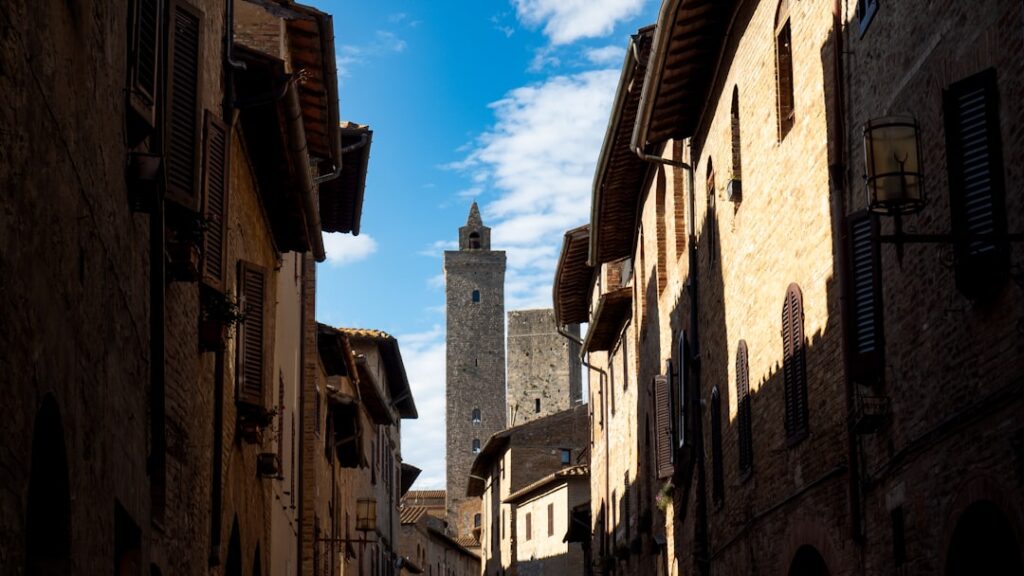






Introduction: Vertical tasting and San Gimignano — a stroll through a wine’s timeline
Vertical tasting is both a sensory and intellectual approach that involves sampling several vintages of the same wine—often from the same estate or cuvée—to observe and understand how it evolves over time. In San Gimignano, the medieval jewel of Tuscany famed for its towers and for its signature wine, Vernaccia di San Gimignano DOCG, this practice takes on a special meaning: landscape, history and the mineral character of the soils intertwine with the climate to shape wines that tell the story of their seasons and years. A vertical tasting here also becomes a lesson in local history, since technical changes and winemaking decisions literally show up in the glass.
With its stone streets, sweeping views of the Tuscan countryside and proximity to historic estates, San Gimignano is the perfect place to grasp wine’s sense of time. Visitors can compare side by side how a dry white like Vernaccia changes from one vintage to the next: the tightening or softening of acidity, fading floral notes, and secondary aromas of honey or almond that may appear after several years. Deciphering these transitions isn’t just for experts — it’s a hands-on learning experience for curious wine lovers, food-focused travelers and anyone who photographs flavors.
This article will walk you step by step through organizing a vertical tasting in San Gimignano, introduce the places and addresses where you can live the experience, outline typical hours and prices, and share practical tips to get the most from every glass. You’ll find immersive descriptions of must-see spots — like the Torre Grossa and the Piazza del Duomo — and of wineries and agriturismi that offer vertical tastings across multiple vintages. We’ll also cover how to “read” a wine in the glass: colour, nose, attack, mid-palate, finish and ageing potential, with concrete reference points tailored to Vernaccia and the Tuscan reds that often accompany the local cuisine.
As you wander among medieval towers, visit a cellar or share a table in the glow of a setting sun, verticality becomes a narrative: the story of a terroir translated into acidity, salinity and texture. This journey is not only sensory; it’s geographic and cultural. You’ll learn where to request verticals (which cellar, which winemaker), how much it typically costs in euros, and how to book smartly to sample three, five or even ten vintages. Finally, you’ll get practical advice on storage, service (temperatures, decanting), and local food pairings — bruschetta with olive oil, pappardelle with wild boar ragù, Tuscan pecorino — that will elevate each bottle.
What is a vertical tasting? Principles, goals and reading the wine
A vertical tasting aims to trace a cuvée’s evolution over time. Unlike a horizontal tasting — which lines up different wines from the same year — a vertical places several vintages of the same wine side by side to reveal the product’s trajectory: aromatic maturation, oak integration, structural changes and tannin development. The educational goals are many: assess ageing potential, spot standout years, understand the impact of a given year’s climate, and measure the effects of successive winemaking choices.
From a sensory standpoint, a vertical is read in sequences. You start with the colour: a young wine (for example Vernaccia 2022) often shows a pale, bright hue, while an older wine (2010) can reveal golden or sometimes amber tones. On the nose, evolution moves from primary aromas (white fruit, citrus) to secondary notes (lees, fermentation) and then tertiary scents (hazelnut, honey, toasted almond, gunflinty minerality). On the palate, a vertical highlights how acidity, salinity and tannins round out or firm up. For San Gimignano’s whites, watch for aromatic persistence, the capacity to retain a mouthwatering freshness after ten years, and mineral impressions.
Practically speaking, a useful session includes at least three vintages: a young one (0–3 years), a middle-aged one (5–10 years) and an older one (10+ years). Professional tastings can feature five to ten vintages to identify constants. Service conditions matter: identical glasses, correct temperatures (8–12 °C for Vernaccia, 16–18 °C for reds), and controlled decanting when needed. Also pay attention to the interval between pours: take breaks, cleanse the palate with plain bread or water, and keep precise notes.
On the logistical side, a vertical requires proper storage (cellar at 12–14 °C, 60–70% humidity), trustworthy provenance of the bottles and traceable storage history. In San Gimignano, some cellars and agriturismi offer verticals led by the winemaker or an oenologist, adding insights on technical choices (tank type, new vs used oak ageing, pressing methods). The price of a vertical can range from €20 (a small three-wine vertical at an osteria) to €100–200 (private tastings of 6–10 vintages followed by a cellar visit), depending on vintage rarity and the producer’s presence.
 Click here to book a 2-hour wine tasting

Why San Gimignano is ideal for a vertical: terroir, history and grape varieties
San Gimignano is more than a listed medieval village; it’s a terroir where geology, altitude and microclimate combine to produce distinctive wines. Vernaccia di San Gimignano DOCG, the local white grape, shows a mineral and saline profile strongly influenced by the clay-limestone soils and the southwest exposure of the hillsides. Year-to-year climate variations — a rainy spring, a hot dry summer, or a wet autumn — influence phenolic ripeness and acidity, elements that a vertical highlights clearly.
There are many emblematic places where you can feel this connection to the land: the Torre Grossa (Piazza del Duomo, 53037 San Gimignano SI, Italy), which offers panoramic views over the surrounding vineyards; the Piazza del Duomo itself, where the Collegiata displays historic frescoes; and the surrounding hills dotted with wine farms like Tenuta Torciano (Località Torciano 16, 53037 San Gimignano) and Fattoria Montenidoli (Località Montenidoli 45, 53037 San Gimignano). These estates often accommodate vertical tastings by appointment.
History matters too: Vernaccia was among the first Italian wines to receive DOC status (1966) and later DOCG. Local archives and farming practices passed down through generations explain pruning and blending decisions. In a vertical, that history translates into sensory differences between a Vernaccia made with traditional methods and one that has benefited from more modern ageing or different grape selection.
Finally, the cuisine of San Gimignano — restaurants like Ristorante Perucà (Via San Martino 17, 53037 San Gimignano, open 12:30–15:00, 19:30–23:00) or Le Vecchie Mura (Piazza delle Erbe 9, 53037 San Gimignano, open 12:00–15:00, 18:30–22:30) — creates ideal pairings to test ageing potential: hard cheeses, pork-based dishes and local recipes that reveal a wine’s structure and persistence. These pairings will help you gauge how a vintage might evolve in the bottle.
Click here to discover vineyards and cellars with tasting

How to organize a vertical tasting in San Gimignano: steps, addresses and budget
Organizing a vertical requires planning. Here’s a sample half-day or full-day itinerary in San Gimignano, with addresses, opening times and indicative budgets to help you book and optimize the experience.
1) Booking and preparation: contact the cellar or agriturismo 1–2 weeks in advance. Examples:
- Tenuta Torciano — Località Torciano 16, 53037 San Gimignano. Hours: visits by appointment generally 09:30–18:30. Vertical tastings: €30–80 per person (depending on number of vintages).
- Fattoria Montenidoli — Località Montenidoli 45, 53037 San Gimignano. Hours: 10:00–17:00 by appointment. Guided vertical: €35–90 per person.
- Enoteca di San Gimignano — Via San Giovanni 146, 53037 San Gimignano. Hours: 10:00–19:00. Vertical tastings and purchases: €15–60 depending on the format.
2) Typical flow of a vertical: welcome and cellar tour (30–45 min), followed by the tasting (3–6 wines) where you usually start with the oldest. Expect 60–120 minutes in total. If the cellar brings out rare vintages, costs can rise (exclusive verticals €120–250). Ask whether water, plain bread and spit buckets are included, and whether tapas or a small cheese board are offered (often +€10–20).
3) Logistics: arrive in San Gimignano early to enjoy the village before the crowds (shops and museums open from 10:00). Parking: Parcheggio Il Montino (Via San Matteo, 53037 San Gimignano) is a public lot often open 24/7; price: about €2–3 per hour, daily rate ~€10–12. Once there, visit the Torre Grossa (Piazza del Duomo, 1): access 10:00–19:00 (high season), ticket roughly €7–10.
4) Practical tips: bring a light jacket (cellars can be cool), note the order of service, photograph labels to record vintages and cuvées, and always ask for the producer’s cellar log to check storage conditions. If you buy bottles, ask about packaging and protection for air travel. Finally, plan to have lunch at an agriturismo after the tasting: many estates offer charcuterie platters and local dishes for €12–25.
Click here to book a vineyard visit with lunch
Recommended addresses for verticals, tours and wine experiences
Here’s a selection of specific places where you can arrange vertical tastings or deepen your knowledge of San Gimignano wines. Each entry includes address, usual opening hours and indicative prices; it’s always best to call ahead to confirm and reserve.
- Tenuta Torciano — Località Torciano 16, 53037 San Gimignano SI, Italy. Hours: visits and tastings by appointment 09:30–18:30. Prices: vertical tasting €30–80 / person; visit + meal €45–120 / person. Tip: ask for the five-vintage Vernaccia vertical and the tour of the historic cellar.
- Fattoria Montenidoli — Località Montenidoli 45, 53037 San Gimignano SI, Italy. Hours: by appointment 10:00–17:00. Prices: €35–90 / person for guided verticals. Tip: great for families and to combine with a walk among the vines.
- Enoteca di San Gimignano — Via San Giovanni 146, 53037 San Gimignano SI, Italy. Hours: 10:00–19:00. Prices: tasting from €15–60 depending on the number of pours. Tip: perfect for an urban tasting and to buy recent vintages.
- Torre Grossa — Piazza del Duomo, 1, 53037 San Gimignano SI, Italy. Hours: 10:00–19:00 (seasonal). Admission: €7–10. Tip: climb for an overview of the visible vineyards and to better understand parcel orientation.
- Museo Civico di San Gimignano — Piazza del Duomo, 1, 53037 San Gimignano SI, Italy. Hours: 09:00–19:00 depending on season. Admission: €5–8. Tip: useful for grasping the region’s historical context and agricultural practices.
Local tips: favor morning tastings to benefit from your freshest senses; avoid smoking or wearing strong perfumes before the session; request neutral glasses (Riedel or similar); and if you’re following a vertical of Tuscan reds (Sangiovese or local blends), try the same bottle again after 30 minutes of aeration to observe aromatic opening.
Click here to discover a wine and food tasting

Conclusion: Learning to read vintages in San Gimignano — memory, pleasure and travel
A vertical tasting in San Gimignano invites you to read wine the way you read a landscape: in layers and perspectives. Each vintage is a page of climatic, human and geological history. In a place where art and agriculture overlap, Vernaccia di San Gimignano and the region’s red wines tell different stories depending on the year — cool seasons that preserve acidity and salinity, and warm seasons that bring richness and opulence. Understanding these nuances through a vertical turns a trip into a lasting lesson: you leave not just with bottles, but with sensory benchmarks and cellar anecdotes to share.
Practically, organizing a vertical takes preparation: booking estates like Tenuta Torciano or Fattoria Montenidoli, respecting serving temperatures, choosing an order of tasting (from oldest to youngest), and maybe enjoying a brunch or lunch to accompany the session. Costs vary but remain accessible: short verticals can start at €20–30, while exhaustive private experiences may reach several hundred euros. The golden rule is the same: ask questions, take notes, and enjoy the winemaker’s explanations — often the most valuable part of the experience.
Finally, San Gimignano offers something beyond a simple tasting: a setting where wine is tasted with the eyes and with memory. After a vertical, take time to stroll the Piazza del Duomo, climb the Torre Grossa to survey roofs and vine rows, and buy a few vintages to bring home — following packing advice for safe transport. A vertical can become a tasting postcard: each vintage a loop through time, each bottle a lasting memory of Tuscany.
Click here to book a small-group vineyard tour
