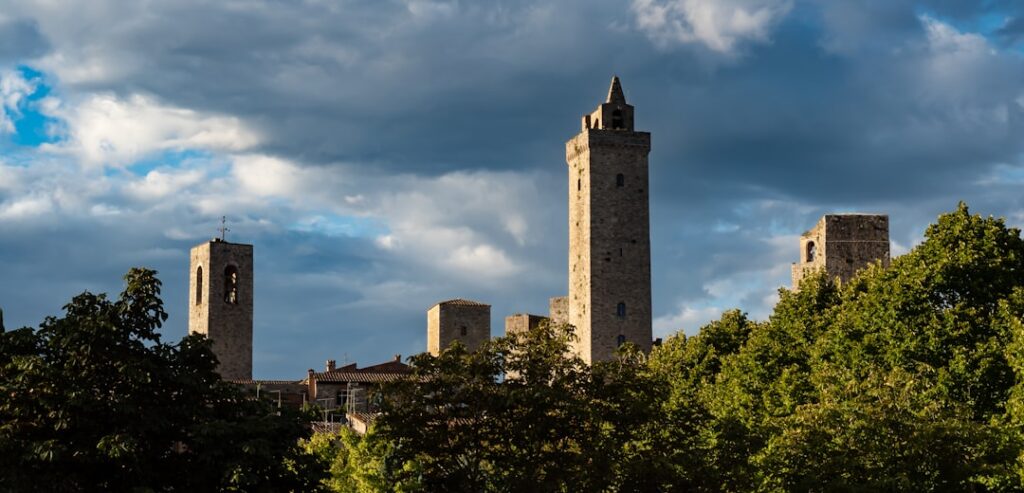






Introduction — A literary stroll in San Gimignano: between towers, stone and pages
San Gimignano, a medieval jewel perched on a hill above the Val d’Elsa in Tuscany, immediately conjures striking images: slim towers rising into the sky, cobbled alleys, and sunlit squares glowing at sunset. But beyond the scenery, the town has long been a wellspring of inspiration for writers, travelers and poets who found here fertile ground for memory, reflection and daydreaming. A literary walk through San Gimignano invites you to read the town like a book, to spot the places that fed stories, to follow in the footsteps of Italian and foreign authors, and to listen to the stones that — silently — tell as many tales as the books do.
This route does more than list monuments; it offers a sensory, narrative immersion where each site becomes stage, set and sometimes character. Here, the Collegiata di Santa Maria Assunta holds prayers and the colors of its frescoes, there the Torre Grossa provides a viewpoint where the eye drifts and the imagination clings. Museums preserve testimonies — archives, manuscripts, paintings — that link the town to its literary and cultural tradition. Cafés and small bookshops complete the picture: you flip through pages while watching an alley, soaking up an atmosphere that itself has inspired writing.
On this walk, I’ll invite you to read San Gimignano as you would a novel: slowly, pausing on details, trying to reconstruct the chronology of faces and events that shaped the town. For each stop we’ll give exact addresses, opening hours, entrance fees and practical local tips — how to avoid the midday crowds, where to find a quiet table to write, which views to favor at sunrise or sunset. Place names and monuments are given precisely so curious travelers can orient themselves and, in turn, plant words into the landscape.
This walk is for both the reader already familiar with Tuscany and the first-time visitor to San Gimignano. It blends historical anecdotes, literary quotes (where appropriate), sensory descriptions and concrete recommendations. As we go, you’ll see how the town, while firmly rooted in its medieval past, offers contemporary perspectives: galleries, independent bookshops, artisan workshops and cafés where people discuss literature over a cappuccino or a glass of Vernaccia di San Gimignano.
Ready for a stroll where stones speak and words catch a Tuscan breath? The walk starts in the shadow of the towers and unfolds across secret squares, museums, churches and panoramas that each writer has been able to turn into a stage. Bring a notebook, a pen and a curious mind: San Gimignano is an open-air book, and every alley hides a sentence waiting to be read.
The Piazza del Duomo and the Collegiata di Santa Maria Assunta — The sacred and literary heart
The Piazza del Duomo, at the very heart of San Gimignano, radiates the town’s historical and literary pulse. Exact address: Piazza del Duomo, 1, 53037 San Gimignano SI, Italy. This square hosts several key landmarks: the Collegiata di Santa Maria Assunta (also called the Duomo di San Gimignano), the Palazzo Comunale housing the Museo Civico, and the imposing Torre Grossa. For the literary stroller, the piazza is an ideal stage to sit and read aloud, imagine dialogues and scenes, or simply jot down impressions.
The Collegiata di Santa Maria Assunta is renowned for its fresco cycles that depict biblical scenes and episodes of medieval daily life — an iconographic treasure for anyone wanting to understand the collective imagination of past centuries. Address: Piazza del Duomo, 2, 53037 San Gimignano SI. Indicative opening hours: usually 10:00–19:00 in high season (April–October), 9:30–17:00 in low season; closed or with reduced hours on religious holidays. Indicative ticket price: access to the complex may be included in a combined ticket « Collegiata + Museo Civico + Torre Grossa » around €9–12 for an adult. Sometimes a separate ticket for the Collegiata alone is available for around €3–5.
Practical tip: arrive early in the morning, ideally at opening, to enjoy the soft light that brings out the fresco colors and to avoid the coach-tour crowds. Sit on the steps or in the center of the piazza to listen to the city’s resonances; many writers mention this kind of deafening silence, populated by murmurs and distant voices.
The Palazzo Comunale / Museo Civico (address: Piazza del Duomo, 1, 53037 San Gimignano SI) preserves archives, paintings and objects that evoke the town’s civic and literary life. Indicative hours: 9:00–19:00 in high season, 10:00–17:00 off season; closed on Tuesdays in some calendars. Indicative ticket price: combined ticket with the Collegiata and Torre Grossa often around €10–15. Inside, look for the rooms exhibiting manuscripts and old documents: here you can read San Gimignano’s written memory.
For literature-loving café-goers, the Piazza del Duomo and its surroundings offer spots perfect for reading and writing. Particularly in the late afternoon, when the light warms the stones, have a coffee near the fountain and let your gaze wander across the façades. Tip: if you’re working on a writing project, jot down ideas on the spot — the Duomo’s atmosphere often has the power to open narrative doors.
 Click here to book a half-day tour in San Gimignano

Torre Grossa and the panoramic view — Writers’ lookout
The Torre Grossa is the tallest of the accessible towers in San Gimignano and offers a panorama that alone explains why so many authors turned the town into a metaphor for time and memory. Address: Torre Grossa, Piazza del Duomo, 1, 53037 San Gimignano SI. Indicative opening hours: generally 10:00–19:00 from April to October, reduced hours November–March; sometimes open later in July/August. Indicative ticket price: around €7–10 for tower access, often included in the Museo Civico combined ticket.
Climbing the approximately 218 steps of the Torre Grossa takes a bit of effort, but the reward is total: from the town’s rooftops to the rolling Tuscan hills, the view fans out. It’s a privileged spot for contemplation among writers; many would happily recite passages describing the horizon, the vineyards, and cypress trees lined up like punctuation marks. Take time to photograph (or imagine) the scene at different times: dawn and dusk transform the colors and the landscape’s dramatic mood.
Practical tips:
– Avoid peak hours (11:00–15:00) to limit waiting; the best times are early morning or late afternoon.
– Bring water and wear comfortable shoes: the staircase is stone and can be slippery.
– If you’re after a literary spark, bring a notebook and spend a while on the upper platform; the air is often calm and conducive to reflection.
For writers, the view from Torre Grossa is versatile: it lets you observe the urban structure (towers, palaces, squares) and the surrounding countryside, and to craft rich visual metaphors. Don’t forget the experience begins on the way up: every landing offers a different perspective, architectural details, niches and worn stones that tell the site’s history.
Click here to book a private guided tour of San Gimignano

Piazza della Cisterna, Via San Giovanni and the romantic lanes — Street scenes and writers’ settings
The Piazza della Cisterna is arguably San Gimignano’s most picturesque square, with its triangular shape, central well and medieval house façades. Address: Piazza della Cisterna, 53037 San Gimignano SI. A short walk away is the Via San Giovanni, lined with artisan shops, small bookshops and cafés that breathe authenticity. These urban spaces make the perfect backdrop for novel scenes: furtive meetings, conversations at a window, characters who watch the horizon from a flowered balcony.
The Piazza della Cisterna, framed by towers such as the Torre dei Becci and the Torre del Diavolo, is a place to sit at a café and compose dialogue or describe the passing crowd’s ballet. Practical tips: the square is often crowded between 11:00 and 16:00 because of tour groups; for a more intimate literary experience, aim for early morning or evening. The shops around the piazza sell books, postcards and local editions that can fuel a writing project or spark inspiration.
Via San Giovanni (which starts near Porta San Giovanni) is a street leading to one of the town’s historic gates. Gate address: Porta San Giovanni, Via San Giovanni, 53037 San Gimignano SI. This stretch retains an old-world charm: irregular cobbles, antique shops and small galleries. For writers, every sign, every wrought-iron shopplate can trigger a metaphor; every window, a portrait.
A detour to the Chiesa di Sant’Agostino (Piazza Sant’Agostino, 7, 53037 San Gimignano SI) will enrich the walk. Indicative opening hours: often 9:00–12:30 and 15:00–18:00, but they vary with services; entry is free or by donation. The interior, more austerely decorated than the Collegiata, offers a reflective atmosphere ideal for note-taking or literary meditation. Tip: look for benches at the back for a quiet spot to write.
For more concrete scenes, stop by Gelateria Dondoli (Piazza della Cisterna, 4, 53037 San Gimignano SI), famous for its artisanal ice cream; a writer might stage a meeting or a bittersweet reflection over a cone. Indicative prices: artisan gelato between €2.50 and €5.00 depending on size and flavors. Hours: usually 10:00–23:00 in high season. A shady bench or a sunny table offers comfortable observation spots.
Museums, bookshops and writing spots — Written traces and cultural anchors
San Gimignano is not just an open-air museum; its contemporary cultural life offers valuable resources for those seeking a deeper literary walk. The Museo della Tortura is not located here (avoid tourist confusion), but the Museo Civico (Piazza del Duomo, 1) and small local collections keep archives of great narrative value. Museum address: Piazza del Duomo, 1, 53037 San Gimignano SI. Hours and prices: see the Piazza del Duomo section above. Inside, look for documents that evoke local chronicles: notarial minutes, guild registers, workshop inventories.
For readers and writers searching for books, the Libreria « Il Vicoletto » (indicative address: Via San Giovanni, historic center) offers a selection of titles in Italian and foreign languages, often focused on Tuscany, poetry and historical guides. Typical hours: 9:30–13:00 and 16:00–19:30; Sunday closures vary. Expect to spend between €10 and €30 depending on editions. Buying a local book is a great way to extend the literary walk when you get home.
Another useful spot is the Biblioteca Comunale (municipal library / cultural spaces), where you can consult books and temporary archives. Address: Palazzo Comunale / Museo Civico, Piazza del Duomo, 1. Ask locally about access to old documents; some consultations may require booking or a small fee (indicative €3–5 for a guided consultation).
Practical tips for writing on site:
– Choose cafés off the main tourist routes for a quieter atmosphere; ask locals for their favorite spots.
– Bring a notebook and pen; power outlets aren’t always readily available in little squares.
– If you want a longer writing session, look for gardens or viewpoints (like the Rocca di Montestaffoli — Via delle Rocche, 53037 San Gimignano SI) that offer tables and benches with a view. The Rocca is a panoramic park that, depending on the season, may be free or request a small contribution for temporary exhibitions (indicative price €0–3).
Finally, for literary meetups: check the calendar of the Fondazione San Gimignano and local associations that organize readings, small festivals and author events, especially in summer and autumn. These events are often free or modestly priced (€5–15 depending on the event). Attending a local reading enriches perspective and lets you feel how the town resonates today in writers’ voices.
Practical tips for a successful literary walk in San Gimignano
To wrap up this exploration, here are concrete local tips to help turn your walk into a deep, serene literary experience. First, timing: high season (June–August) brings heavy crowds; if possible, favor spring (April–May) or autumn (September–October) for mild temperatures and a less hurried atmosphere. In low season, some museums and shops may close earlier, so always check current opening hours on official sites.
Transport and parking: San Gimignano is reachable by car from Florence (about 60–70 km) and Siena (about 45 km). Main parking lots are located outside the historic center (e.g. Parcheggio Porta Savina, Via San Matteo; Parcheggio Pian dei la Funa). Expect daily rates to vary: roughly €2–4 per hour or €6–15 for the day depending on season. The center is largely pedestrian; prepare your legs for cobbles and uphill stretches.
On-site budget: entry to main monuments and combined museums €10–15; coffee drinks around €2.50–5.00; a meal at a local trattoria €12–30 per person depending on the menu. If you want to buy a paper guide or a local poetry collection, budget €10–25. For a public reading or a small workshop, allow an extra €5–20 depending on the organizer.
Safety and comfort: San Gimignano is a safe town, but take usual precautions against pickpockets in very touristy areas. Carry a reusable water bottle — public fountains are rare in main streets — and wear a hat in summer. Streets are stone and sometimes narrow; choose non-slip footwear.
Local interactions: if you want to enrich your walk with local anecdotes, talk to booksellers, municipal guides or trattoria owners — most speak at least some English, but a smile and a few words in Italian (Buongiorno, Grazie) go a long way. Locals appreciate curious, respectful visitors.
Finally, to prolong inspiration after your visit: carry a notebook to jot down lines, images and impressions, or buy a local book to read beneath a cedar tree or on a panoramic bench. The true value of a literary walk isn’t only in the monuments visited but in the visitor’s ability to connect sensations and words, to listen to echoes of the past and to turn the stroll into a personal narrative.
Click here to book a full-day excursion to Siena and San Gimignano

Conclusion — Writing San Gimignano: memory, landscape and the act of writing
San Gimignano is a place where architectural history and literary memory meet and answer one another. Walking the Piazza del Duomo, climbing Torre Grossa, wandering through Piazza della Cisterna and lingering in bookshops and museums, the stroller reads the town as if leafing through a manuscript: pausing on details, reassembling timelines and letting imagination weave bridges between past and present. The Collegiata’s frescoes, the Museo Civico’s archives, the shaded lanes and the viewpoints beyond the walls are all stages where possible narratives play out.
This literary walk doesn’t require specialized historical knowledge; it asks above all for attention to sensations, patience for the town’s rhythms and curiosity for local voices. The precise addresses, indicative hours and prices make practical trip planning easier, but the essential remains intangible: the images the town plants in your mind, the sentences that emerge around a stone, the way light transforms a façade at a particular hour. For the writer, the reader or the casual stroller, San Gimignano offers a field for narrative experimentation where every step can become a paragraph.
If you set out on this walk, take the time to observe, listen and write. Sit for an hour on a bench, flip through a book in a shop, watch the sun sink from Torre Grossa, let the smell of bread and wine accompany your impressions. Leave with pages full of words or simply with memories amplified by the site’s beauty. San Gimignano, with its towers, squares and archives, is a book that’s always alive: it awaits new readings and new writings. May your visit be the start of a story, an essay, a poem or just a private notebook — the town will give you the scenes to feed your pen.
Happy literary travels, and remember: true discoveries aren’t counted by monuments visited but by the sentences you write and the images that stay with you.